

![Visual Manifestations of Recent History [Interview with Darije Petković]](https://mihacolner.com/wp-content/uploads/2026/06/Darije-Petkovic-Crvena-luka-2017-670x300.jpg "Visual Manifestations of Recent History [Interview with Darije Petković]")
The interview with photographer Darije Petković was first published on the GBJ blog during the preparations for the exhibition Damnatio memoriae in 2021 at Galerija Božidar Jakac – Museum of Modern and Contemporary Art.
For many years Zagreb-based photographer and visual artist Darija Petković has been researching and analysing the ways in which history and memory are constituted. Through the medium of photography and appropriation of found objects, he has presented his view of a cultural landscape that has been shaped by numerous historical events and inscribed in collective memory by public and media discourses. His works insightfully observe and comment on the consequences of the social, ideological and economic transition in Croatia and in the wider region.
The most recent is the Damnatio memoriae series that focuses on stories about the revision of the past and about how the understanding of history is conditioned by geographical and cultural perspective. The piece highlights some of the more or less significant events in recent history that still today cause ideological disputes, such as, for instance, the story of the forgotten extermination camp Uvala Slana on the island of Pag, which operated in 1941 within the framework of the Independent State of Croatia (NDH), the event in the Bedenik forest near Bjelovar, where a radical Yugoslav National Army (JNA) major killed eleven members of the Croatian armed forces in a suicide attack in 1991, and appropriated photographs from 1991 showing informal meetings between the presidents of Croatia and Serbia, Franjo Tuđman and Slobodan Milošević, the content of which, in the absence of minutes, remains a mystery to this day. For more than fifteen years, Petković’s creative practice has focused on local histories. For example, in Occupation in 26 Images (2008) he addressed the economic occupation of Croatia resulting from the processes of transition to parliamentary democracy and free market. In the series Ghosts of the Past (2008-2013) he touched upon the pathologies of politically motivated historical constructs, while in the series Ilica 01. 09. 2013 (2013) he documented the consequences of disintegration of the economic and social infrastructure on Ilica, Zagreb’s once main shopping street.
Petković’s artistic practice has been marked in many ways by his prolific work in various fields of photography. He began his career as a newspaper photographer who worked for a number of Croatian newspapers and magazines, such as Nacional, Poslovni tjednik and Globus, before taking up a position of a professor at the Photography Department at the Academy of Dramatic Arts in Zagreb in 2005. Since then, in addition to his teaching, he has been focusing mainly on art projects, which usually exist on the boundary between visual arts and social sciences. In this interview, we primarily discussed his recent work Damnatio memoriae, which premiered in 2019 at the Vladimir Bužančić Gallery in Zagreb (curated by Anita Zlomislić), and was later showcased at Galerija Božidar Jakac – Museum of Modern and Contemporary Art, Kostanjevica na Krki, and raised some key questions about the connections between photography, art and society.
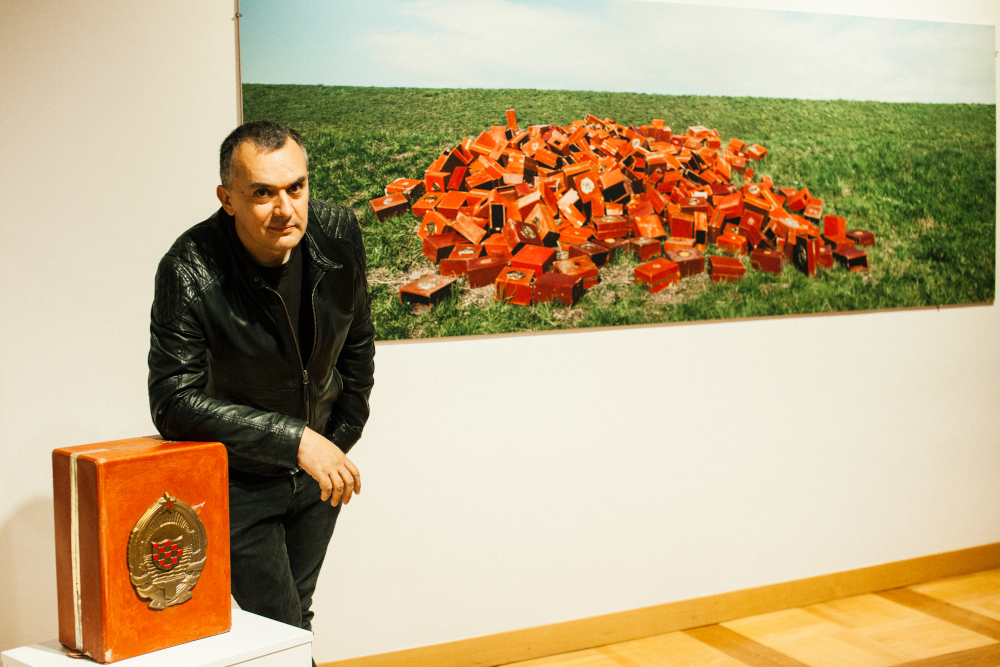
Darije Petković at the opening of the exhibition Damnatio memoriae, Galerija Božidar Jakac – Museum of Modern and Contemporary Art, Kostanjevica na Krki, 2021. Photo: Jurij Vižintin.
What was your motivation for the project Damnatio memoriae, where you focused on the recent revisions of history and collective memory? Is this phenomenon so ubiquitous that you simply could not get around it?
Revision of history is certainly a ubiquitous phenomenon. In the past, I have already repeatedly dealt with themes that reflect certain historical circumstances, for example in the series Assassination of Sarjevo (2014) or Ghosts of the Past (2008-2013). I obviously have a significant interest in history and certain sensibility for such themes, which may also be partly related to the fact that I worked as a photojournalist for many years. The revision and perception of the past are ubiquitous sociopolitical themes that I interpret by using photography.
The revision of history is by no means new or locally determined phenomenon, since it has occurred repeatedly everywhere throughout the history. You must have been mainly referring to the Croatian context, because you are the most familiar with it?
Croatia is quite specific in terms of how the society is ideologically polarised. The polarisation is based on the issues related to the World War II and the consequent socialist period and these two themes are commonly met with tumultuous and divided reactions. I am not a historian, but I know the historical circumstances well enough to research them and test the social climate, and then react to them. Many of my projects have been made through a very slow process, such as Talks with no Witnesses, part of the ongoing Damnatio memoriae series (2017-2024), which is based on photographs of secret conversations in 1991 between then Croatian president Franjo Tuđman and Serbian president Slobodan Milošević. I have had these photographs in my possession for twenty years, but have only recently interpreted and presented them. In a similar way, I have undertaken a piece in which I reacted to a book of impressions from the abandoned 25 May Museum in the town of Drvar, Bosnia and Herzegovina, which I found there immediately after the military activities ceased in the area in 1995. I found the book of impressions discarded in a pile of rubbish but have waited a long time for the right opportunity to showcase it in the appropriate context. The work Konjić’s Leap (2019), based on this book of impressions, was exhibited in 2019 as part of the group exhibition When Monuments Come Alive at Nova Gallery in Zagreb.
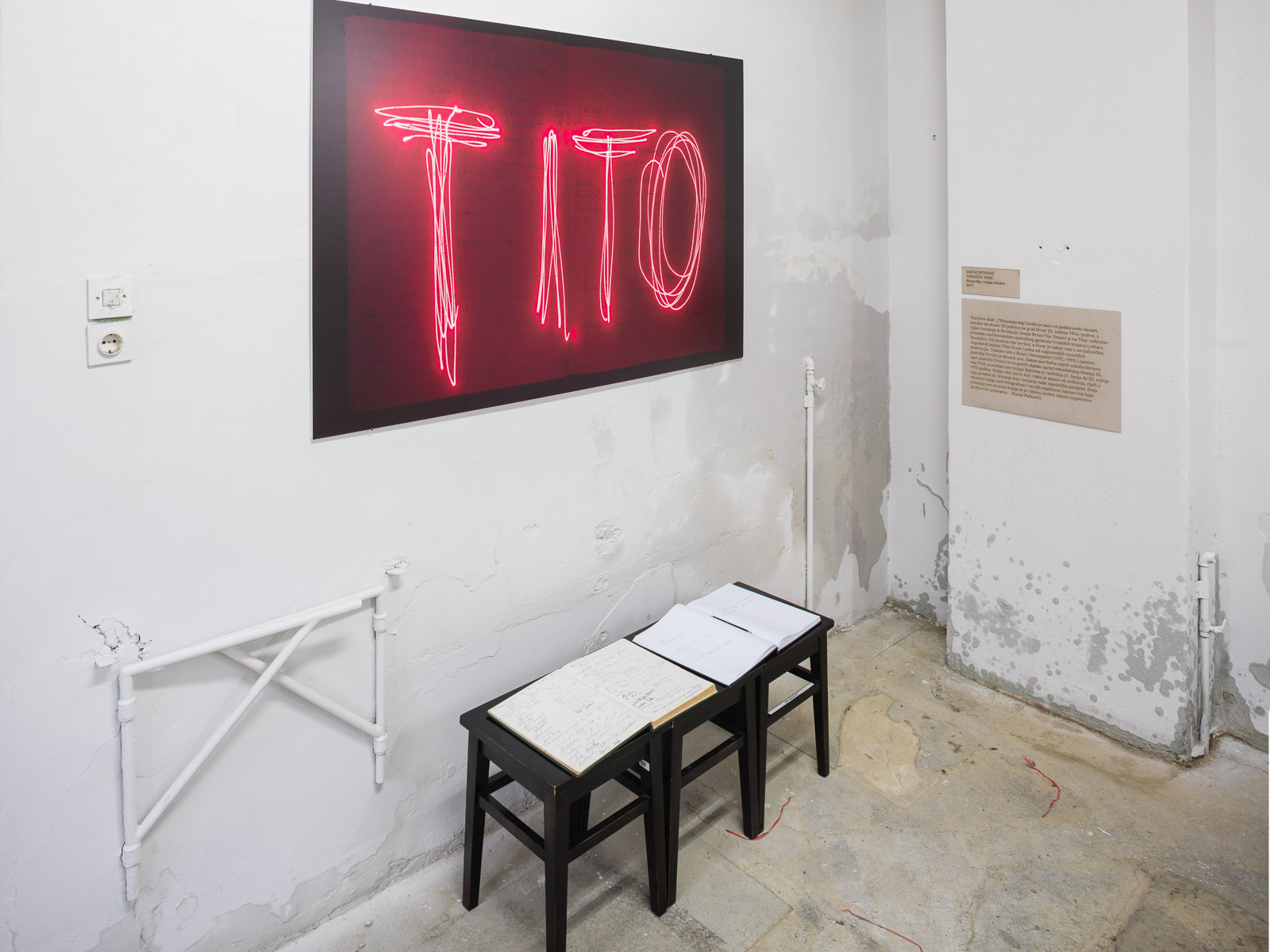
Darije Petković, Konjić’s Leap. The group exhibition When Monuments Come Alive, Galerija Nova, Zagreb, 2019.
Did you exhibit only the book of impressions as a ready-made, or did you interpret it in other ways?
I laser-printed slogans that were popular at the time on this book of impressions from the 1970s. The reason for that was also the fact that the name of Josip Broz Tito still dominates local political discourse. His legacy is still there, and only last year, opinions clashed again when Marshal Tito Square in Zagreb was renamed to Republic of Croatia Square. The work Konjić’s Leap is therefore interesting from the perspective of understanding the Zeitgeist of the 1970s, when Yugoslav socialism was still breathing at the top of its lungs. That is why the reflections of the former museum visitors from that time can be found in this book of impressions.
You probably came to Drvar in 1995 on an assignment, as a photojournalist?
At that time, I was working on a story for Nacional magazine about a military operation that had ended about a week earlier. One of the first things I did after arriving in Drvar was to visit the Museum of 25 May 1944, which was completely devastated. In front of the museum I came across a pile of rubbish where I found a book of impressions and saved it from ruin. At that time I had no plans what to do with it, but it seemed to me that I had to preserve it. In such an emergency situations, one cannot buy souvenirs, fridge magnets, but there are meaningful objects everywhere. In a similar way, I have often saved things that I find interesting, things that would otherwise have been thrown away. To this day, I have managed to build up a small collection of objects that I occasionally include to my exhibitions. I could say that I never look for specific cautions, but that they find me. Maybe it is just luck or visual sensitivity that I notice and recognise such things at all. In a similar way, I acquired the ballot boxes that are now part of the Damnatio memoriae exhibition.
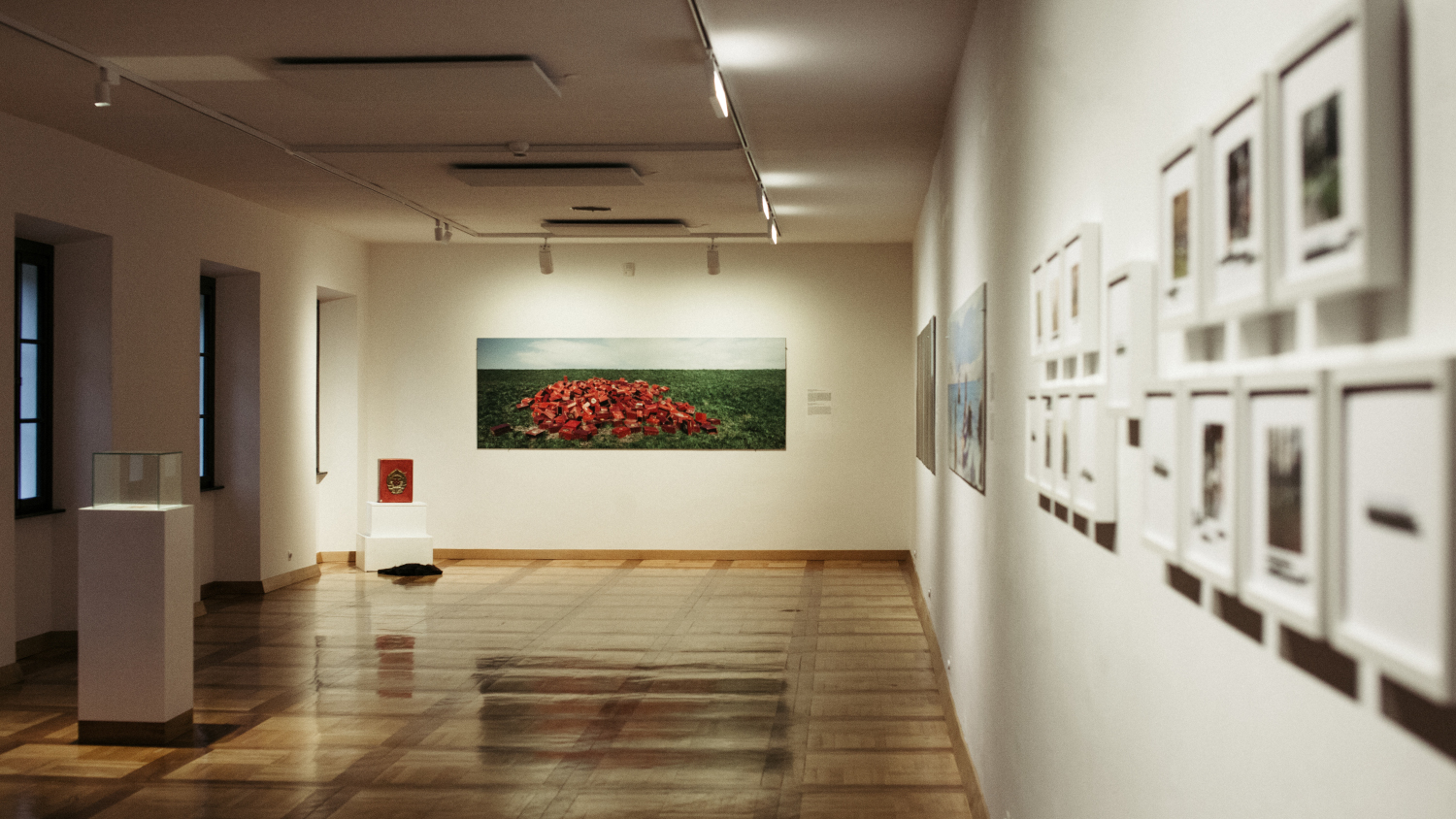
Darije Petković, Damnatio memoriae, Galerija Božidar Jakac – Museum of Modern and Contemporary Art, Kostanjevica na Krki, 2021. Photo: Jurij Vižintin.
You mentioned that for many years you worked as a photojournalist for various newspapers. What is the difference between working for the media and creating materials for exhibitions? Are there any similarities between the two?
A better description would be that I worked as a portrait photographer for newspapers, but I also did various reportages. I stopped working for the mass media in 2005, when I joined the Department of Photography at the Academy of Dramatic Arts in Zagreb, and focused mainly on educational work. The biggest difference is that in my artistic projects I do not depend on a client, so I can exclusively work on themes that interest me. Of course, working for the media has surely left a certain influence on my creative practice, especially regarding the choice of themes and how they are addressed.
You mentioned that in your work you often interpret very complex historical phenomena using photography. Is it difficult to visually manifest such phenomena?
Of course, it is often very challenging. The question of how to process certain historical and social themes in a visual language is constantly present. I often document places where more or less significant historical events took place. A good example is the work Sarajevo Assassination which reflects an important change of context that is geographically conditioned. My generation was taught in primary school that the Sarajevo assassination was an act that emancipated the Yugoslav people and freed them from the influence of Austria-Hungary. Today, however, in Slovenia and Croatia this event is interpreted in a completely different way than it is in Serbia, for example.
In a similar way, in the Damnatio memoriae series, I have exposed, among other things, the historical event in Barutana, Bjelovar, in 1991, which marked the break-up of Yugoslavia. At that time, the Presidency of Yugoslavia decorated the JNA officer who died in a suicide operation in which he blew up an arms depot at the moment when soldiers of the Croatian army were entering it in order to demine the place. Paradoxically, he became the last National Hero of Yugoslavia. The history of Yugoslavia has been founded on the stories of national heroes, with streets and factories named after them, from Rade Končar and Marijan Badel in Zagreb, to Djuro Salaj in Krško. But this tradition ended with the decoration for a bizarre suicide attack. Therefore, today, the aforementioned JNA major is labelled a criminal in Croatia, while in Serbia he still enjoys the status of a hero. There are many such examples.
The perception of history depends on the angle from which it is viewed and how it is interpreted. We often hear that history is written by the winners, however, controlling it is usually not just about shaping current history, but it often involves attempts to rewrite it retrospectively. For example, the history of the World War II today depends to a large extent on political orientation, or even on the intimate views of an individual. In this way, even the good things that socialism undoubtedly brought are negated today. But that is what happens in all conflicts. Erecting monuments and memorials to people who are controversial for one side but not for the other is quite normal. For example, an assassin like Gavrilo Princip is a typical example of such situation: he is glorified by one side and demonised by the other. This is a typical story of the former Yugoslavia.
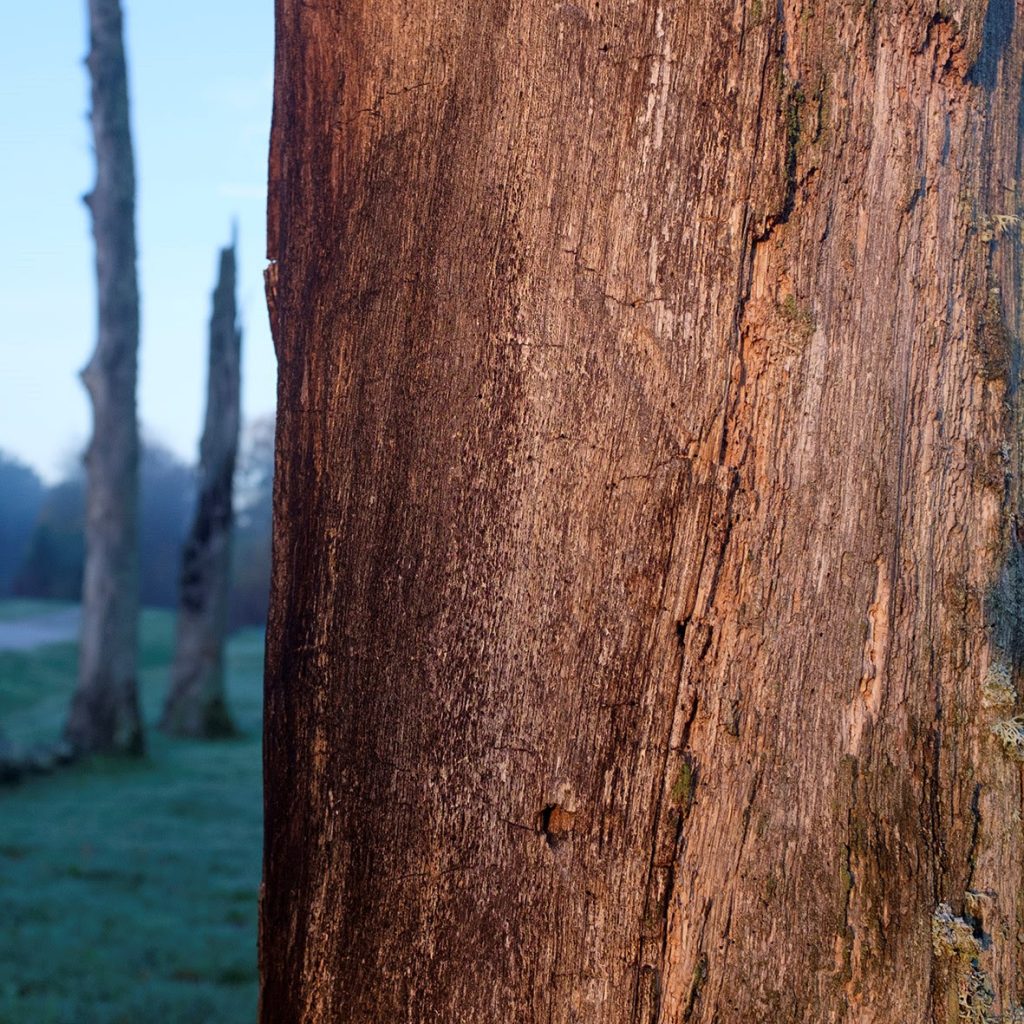
Darije Petković, Bedenik Forest, from the series Damnatio memoriae, 2018.
You mentioned the event in Barutana in Bjelovar, which you presented with the work entitled Šuma Bedenik within the Damnatio memoriae exhibition, where you have chosen a very effective visual solution. In this case, the photographs cannot tell the whole story on their own, so they require text. The need for additional texts seems to be quite frequent in your work.
This issue is quite common. But in many of my past works, I have not needed or used text, as I have been more concerned with the visual elements, the photographs. In the Damnatio memoriae series, it would be very difficult to get the full context, that are very particular and complex, only by viewing the photographs. In the work Šuma Bedenik I focused on showing the traces of this bloody event on the trees. Although the trees are still completely destroyed or badly damaged today, they have recorded in their structure this tragic story of the explosion of the arms depot thirty years ago.
Would you agree that the Damnatio memoriae exhibition is somewhat reminiscent of a museum display, where the images are usually accompanied by an explanatory texts?
In contemporary photography, text is often used to help read, understand and interpret a work in the way the artist wants. This is one of the principal differences with the process that prevails in photojournalism, where a photograph of an event can completely lose its original meaning and context because of the description contributed by a journalist or editor. The press photographer has usually very little control over his images, even though he was the one who witnessed and recorded an event. Text always strongly determines the understanding of a photograph.
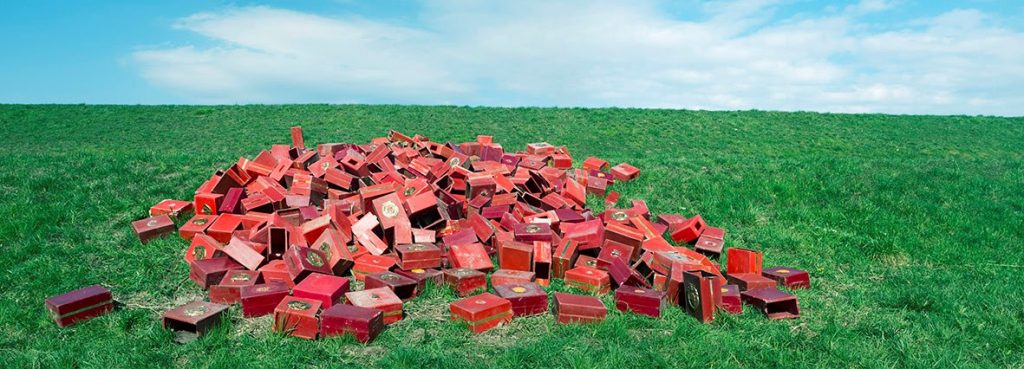
Darije Petković, The Sava-Odra Canal, from the series Damnatio memoriae, 2018.
You mentioned the ballot boxes, which are one of the most exposed works within the Damnatio memoriae exhibition. What is the story behind this photographs and installation?
In 2018 I came across the information about the discarded ballot boxes in the media. I found it incredible that ballot boxes from the Yugoslav era were dumped next to the Odra-Sava canal near Zagreb. I quickly found this ‘installation’ in the landscape, where someone had apparently dumped a truckload of ballot boxes. I took a photograph of these boxes on the spot, and I took some of the boxes home, as I assumed that the municipality would clean things up. But the story quickly spread in the media throughout the region, so someone returned to the scene at night to ‘clean up’ the area, and that is when these boxes were set on fire, as they were made of synthetic (plastic) materials.
Do you know who dumped and burned the boxes, or who ordered it?
The police announced at the time that they were conducting a criminal investigation, but I did not check later whether this story had even been followed up. However, judging from the comments on online portals, these boxes bothered many people. For example, the more right-leaning web portals publicly proclaimed their dislike of the socialist insignias on these ballot boxes, even though these were the boxes used at the first free multi-party elections in Croatia in 1990. Later on I found photographs of the then presidential candidate and later president Franjo Tuđman and his colleagues dropping a ballot paper into an identical (or perhaps even the same) box. These ballot boxes are therefore artefacts that are closely linked to the process of Croatian independence, and I therefore see them primarily as a historical relic.
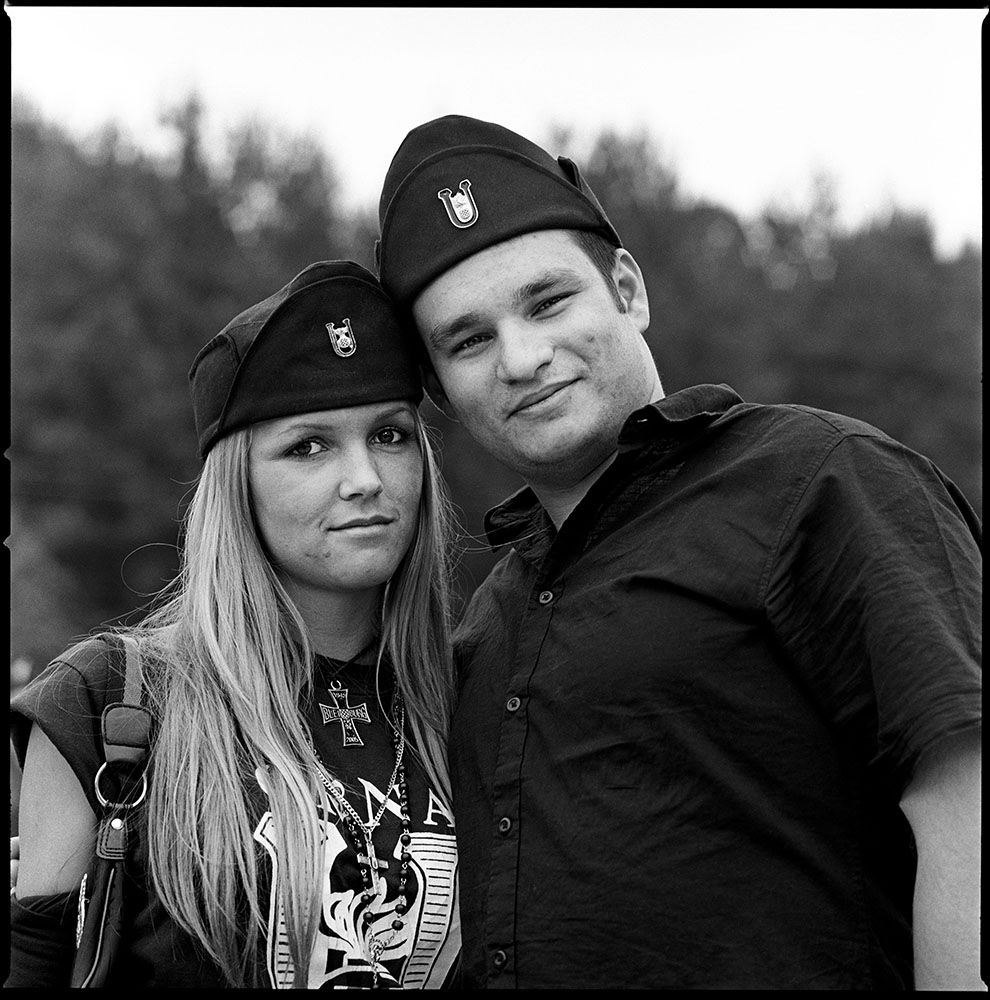
Darije Petković, Ghosts of the Past, 2008-2013.
In your past projects, you have often dealt with the past and its impact on the present in a similar way. One of your more recognisable series is Ghosts of the Past, where you portrayed people who identify with past ideologies and regimes. Why did you feel it was important to record people masquerading as Ustaše, Chetniks and partisans?
The phenomenon of the World War II fascinates me because it simply never ends. The wars in the former Yugoslavia in the 1990s were also very much impacted by that spirit. The World War II is a subject that still deeply polarises the society in Croatia. There are several commemorations in the month of May; first there is the commemoration in Bleiburg, where the army of the marionette fascist Croatian state (NDH) laid down its arms, which has recently been restricted and banned by the Austrian authorities. Then there is the gathering of the supporters of the Chetnik movement in the vicinity of Ravne Gora in Serbia. And furthermore, on 25 May people from entire former Yugoslavia flock together to in Kumrovec to celebrate the birthday of former president Josip Broz Tito. At all these celebrations, many people dress up in uniforms from the World War II.
In Kumrovec, on the former Day of Youth on 25 May, there is always a lot of exhibitionism, with people dressing up in partisan uniforms or even in Marshal Tito’s uniform. The entire event therefore appears like a carnival. As a result, the atmosphere in Kumrovec is quite positive, because it is a birthday celebration. In Bleiburg, it is quite different, because the event commemorates the place of suffering of the members of the NDH army. In short, there are celebrations that occur in three consecutive weekends in May, so I was at one of these gatherings every Saturday. The photographs from these manifestations are meant to be a social commentary on identification and attitudes towards this bygone period. Whenever the work Ghosts of the Past has been exhibited, it has provoked quite strong reactions on all sides.
The people in these photos were obviously posing for you?
Yes, I basically asked them if I could take their picture and nobody had a problem with that, because they actually came there to be seen and to publicly show their ideology. I communicated directly with the people in Bleiburg and Kumrovec, while on Ravna Gora I had a colleague from Serbia with me who helped me with communication. If people recognised my dialect, they might not want to be photographed or they might want to engage in conversation, which I avoided. Coming to a Chetnik assembly from Zagreb might have seemed a provocation in itself.
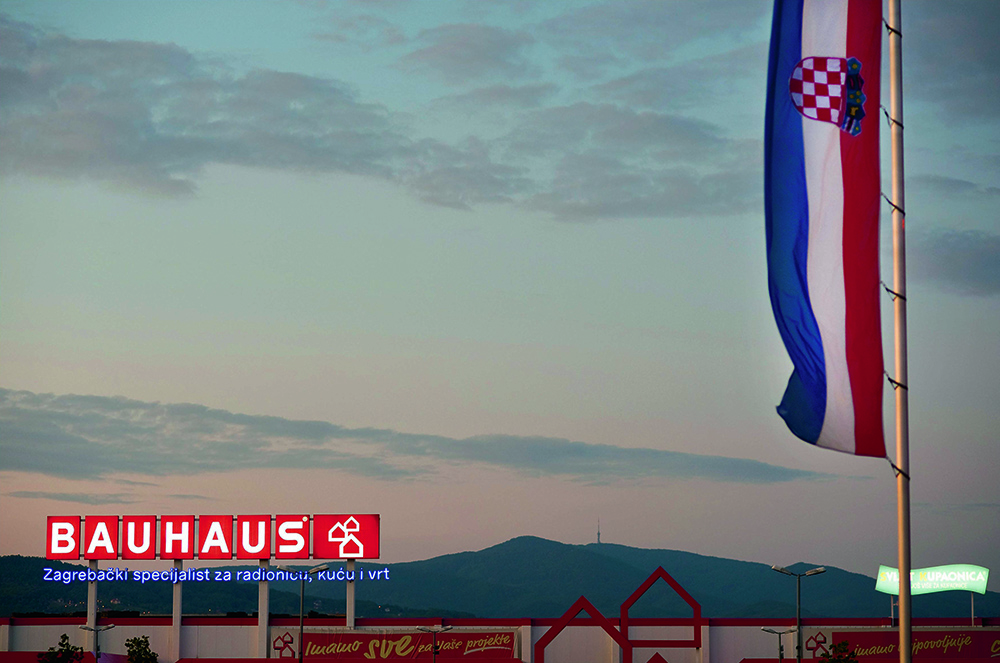
Darije Petković, Occupation in 26 Pictures, 2008.
In the project Occupation in 26 Pictures (2008) you confronted images of contemporary neoliberalism and national symbols, which in itself sounds like a contradiction. What interested you in this project?
Up until now we have talked a lot about wars and conflicts, which I have often addressed in my work. Today, modern societies have adopted a different way of taking over a country and its vital infrastructure, i.e. banks, telecommunications, insurance companies, media, trade, tourism and so on. When I added it all up, I realised that Croatia’s independence lasted for a very short time, since the entire economy and strategic infrastructure was quickly sold off. The symbolism is also similar; when an emperor appears in an area, the flags will be immediately displayed, and similarly, nowadays, corporations come and display their logos; the situation is pretty much the same in Slovenia, in Croatia or in Germany. At that time it seemed important to me to record the takeover of important strategic infrastructure in contrast with national symbols such as flags, coats of arms, monuments. In this series, I simply sought for the places where these contradictions are visible, where corporate and national symbols meet.
Many of the corporations that are nowadays present in Croatia come from areas that once had territorial claims over Croatian and Yugoslav territory. Eighty years ago, the Italian army had to invade Dalmatia militarily, but did not stay there beyond 1943. Today, however, we have in Dalmatia many symbols of modern Italy, which, although it no longer has official territorial claims, in economic terms lots of profits from this area end up in Italy through the private companies. I call this the modern occupation. The question is, what constitutes a state? Is it merely a territory, or are there also important economic and infrastructural mechanisms? That is why I have confronted the symbols of corporations and national symbols and, simply to question their meaning nowadays.
Most of the right-wing political options in modern Croatia are very critical of the period of socialist Yugoslavia, but on the other hand, nowadays, the state sold off most of the industry that was created during the socialist period, and therefore only few people make profit. This is the general situation that one can notice on many levels of society. For example, housing issues were undoubtedly better and more equitably dealt with during the Yugoslav period than they are today. At that time, housing for citizens was built according to some central plan, and people were given homes with non-profit prices. Nowadays, on the other hand, people have to borrow money from a foreign bank and pay off their housing at almost double price, while they continue to live in an apartment that is not theirs for another thirty years, fearing the loss of their job, which could prevent them from paying the loan instalment on time. If one fails to pay loan instalment happens, the bank takes the whole apartment, not just the outstanding part. However, these measures are executed by national police and judiciary and not, for example, by the Italian landlord and the Italian police. The Croatian police carries out the eviction on the behalf of a bank. These themes appear in the undertones of this series. I took the title of the series, Occupation in 26 Pictures, from Lordan Zafranović’s controversial 1978 film about the Italian occupation of the town of Dubrovnik and the activities of the Quisling forces.
This is clearly the story of the transition we have been witnessing for more than thirty years. You took up a similar theme but different approach in your project Ilica 01.09.2013, where you photographed in one day the empty spaces on this once main shopping street, which was considered a kind of high street of Zagreb.
Yes, this series was made in a single day in 2013. At that time, I walked through the innermost centre of Zagreb and chose two spots, Ban Jelačić Square, which is named after an important historical figure, and Franjo Tuđman Square, which is named after, as he is often called, the father of modern Croatia. What happened between these two points? There was a complete collapse of economic activities, so I photographed empty spaces and shattered shop windows. In a distance of three kilometres, the situation was quite telling – it was getting significantly worse the further I moved away from Ban Jelačić and closer to Franjo Tuđman.
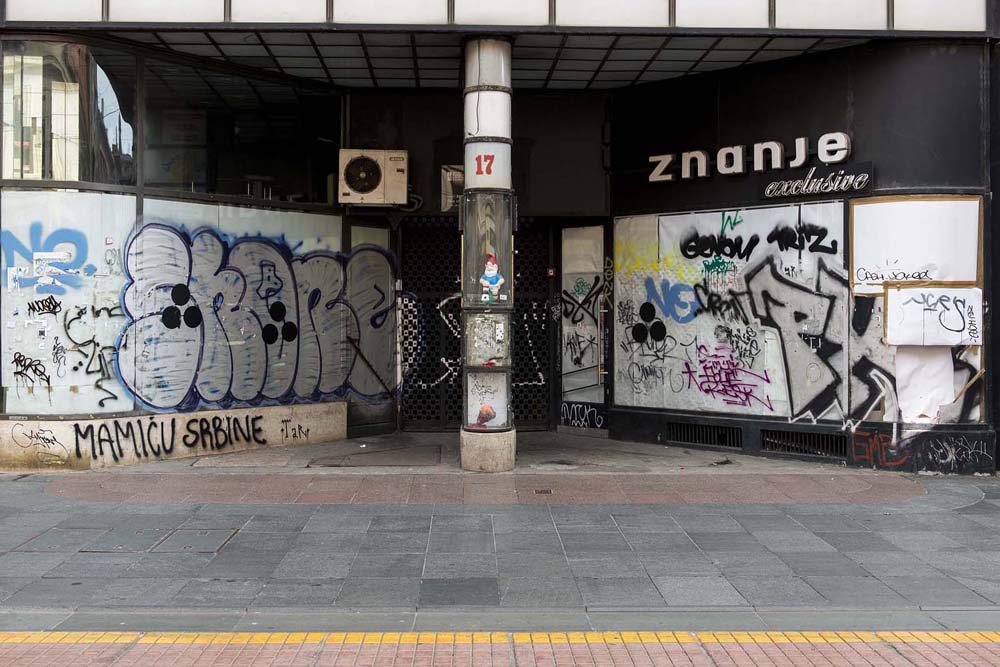
Darije Petković, Ilica 01. 09. 2013, 2013.
Finally, I would like to know what you are working on in the future. I have seen that you are working on the stories about Matija Gubec and the Peasant Revolt of 1573, which are two phenomena or events that have been increasingly forgotten in recent period of time. How do you approach this theme and how do you deal with forgotten historical phenomena?
In this case, I am again dealing with a very important historical phenomenon that has changed significantly over time. As I have already mentioned, Yugoslav history was based on a mythology of national heroes. However, the last war in the 1990s did not very clearly define a mythical figure, like during the World War II; in Croatia, conditionally speaking, the most exposed is general Ante Gotovina, who is still alive but he does not yet have a mythical status. If one asks a question who is the greatest hero in Croatian history, the answer is clear – it is undeniably Matija Gubec, a alleged leader of the Great Peasant Revolt who links two areas, Croatia and Slovenia, that are very close to me since I grew up there. The spirit peasant revolt, that took place in 1573 in the vicinity of Stubica and Krško, is still very alive in these areas. There are still events being organised where people dress up in costumes to re-enact the battles between peasants and noblemen, the autocrats of that time. Part of the project that is still in process is likely to consist of traces of the myth of Matija Gubec, since many streets, squares and public buildings bear his name. In Belgrade, there used to be the Matija Gubec street, but it has recently been renamed. I find this processes extremely interesting and amusing, and on the other hand, because of a huge time gap, it is also less politically controversial. Similar to most of my projects, also this piece looks into certain historical periods from the modern perspective since I am interested in what is their influence nowadays. But actually, I do not know quite yet where this is all going to bring me yet. It is still a work in progress.
© Miha Colner, September 2021
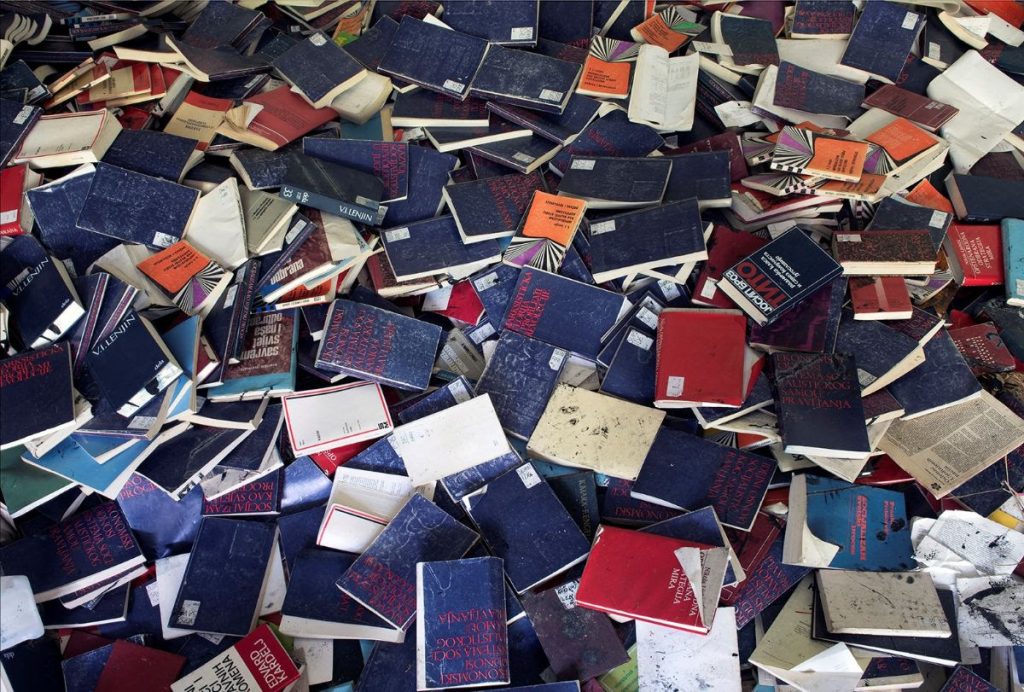
Darije Petković, The Library of the Political School SKJ Josip Broz Tito, Kumrovec, from the series Damnatio memoriae, 2018.